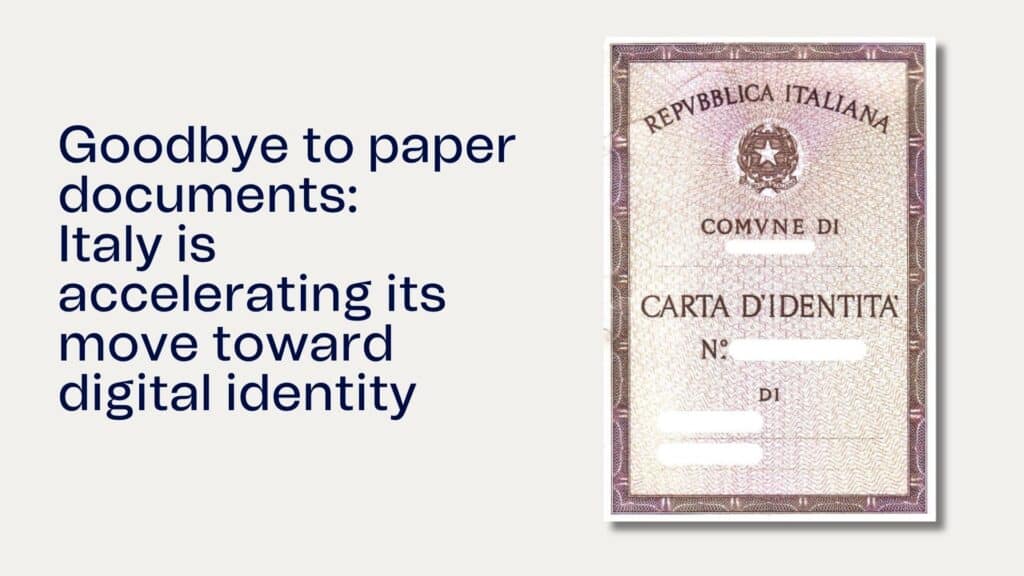
On August 3, 2026, Italy will reach a definitive milestone in its digital transformation. Pursuant to EU Regulation 2019/1157 and Ministry of Interior Circular No. 76/2025, all traditional paper identity cards will officially lose their legal validity.
For the financial, insurance, and telecommunications sectors, this represents far more than a simple document update: it requires a priority extraordinary review of customer profiles within KYC (Know Your Customer) processes. This guide outlines the regulatory requirements, the operational risks of manual migration, and the strategic advantages of automated identity verification.
1. The Regulatory Framework: Why Change is Mandatory
The transition is not merely administrative but a security mandate aimed at harmonizing identity standards across the Eurozone.
| Regulation | Key Requirement | Business Impact |
|---|---|---|
| Art. 14 (EU) 2019/1157 | Technical Specifications | Documents must now include a biometric chip (NFC) to prevent counterfeiting. |
| Art. 11 (EU) 2019/1157 | Data Integrity | Entities must ensure the “security, integrity, and authenticity” of the data accessed. |
| Art. 10 (EU) 2019/1157 | Biometric Consistency | Identity must be verified via high-security storage media (CIE/Passport). |
2. Market Scenario: The Current “Update Wave”
As the deadline approaches, the Italian market is seeing a major surge in requests for new documents. Currently, the response from leading institutions is split into two primary strategies:
- Traditional Manual Management: Many organizations ask customers to submit new data via email attachments (scanned PDFs or images) or through physical branch appointments.
- Digital Identity Integration: Other entities are focusing on the synergy between the new Electronic Identity Card (CIE) and existing digital credentials (such as SPID) to bridge the gap in accessing online services.
- The Operational Challenge: While proactive, the manual approach introduces security vulnerabilities and operational bottlenecks. Relying on insecure tools and manual checks not only risks data protection but paralyzes operations during peak times when scalability is critical.
3. The Hidden Cost of Manual Labor
When the volume of data changes becomes massive, the absence of automation exposes the organization to three systemic weaknesses:
- Back-Office Congestion: Relying on large-scale manual verification tends to limit system response capacity. Any backlog could delay profile activation and disrupt transactional flows.
- Human Error and Data Fatigue: As volume increases, so does the risk of data entry errors. Manual operations also carry a higher risk of failing to detect sophisticated counterfeits during peak periods.
- Operating Expenses (OPEX): Hiring or reallocating staff to handle a temporary surge is inefficient; it is an expense that creates no future value.
4. Moving from “Manual Review” to “Automated Validation”
The only way to manage a wave of this magnitude without increasing headcount is automation. The transition to CIE offers a unique opportunity to improve data quality:
- NFC Instant-Fetch: The new CIE contains a biometric chip. Instead of having a person type in data, our technology reads the chip to extract 100% accurate data in seconds.
- AI-Powered OCR: For web flows, advanced OCR (Optical Character Recognition) instantly extracts all CIE data, eliminating the burden of manual entry for both the customer and staff.
- Automated Anti-Fraud Screening: Automated systems check security features (holograms, micro-text, and chip authenticity) far more reliably than the human eye viewing a low-quality email attachment.
Veridas Expert Insight: Global Scalability for the Italian Transition
As a global leader in identity verification, Veridas provides the technical infrastructure to turn the August 3 deadline into a seamless digital experience. The robustness of our solution is proven at scale: in markets like Mexico, where strict regulatory guidelines created a similar “identity wave”, we enabled businesses to successfully manage the connectivity and identity of millions of citizens within very tight timeframes.
Our technology is specifically optimized for the Italian CIE, offering performance levels designed to “ride the wave” of high-volume updates:
- Extreme Scalability: Proven capacity to handle over 2 million processes per month and peaks of over 600 processes per minute, ensuring no operational bottlenecks during the August rush.
- Guaranteed SLAs: Consistent performance with enterprise-level Service Level Agreements, maintaining system stability even during maximum customer activity.
- NFC Validation: Instant authentication of the document’s biometric chip for 100% data accuracy.
- Compliance by Design: Automated workflows that meet all GDPR and EU Regulation 2019/1157 standards.