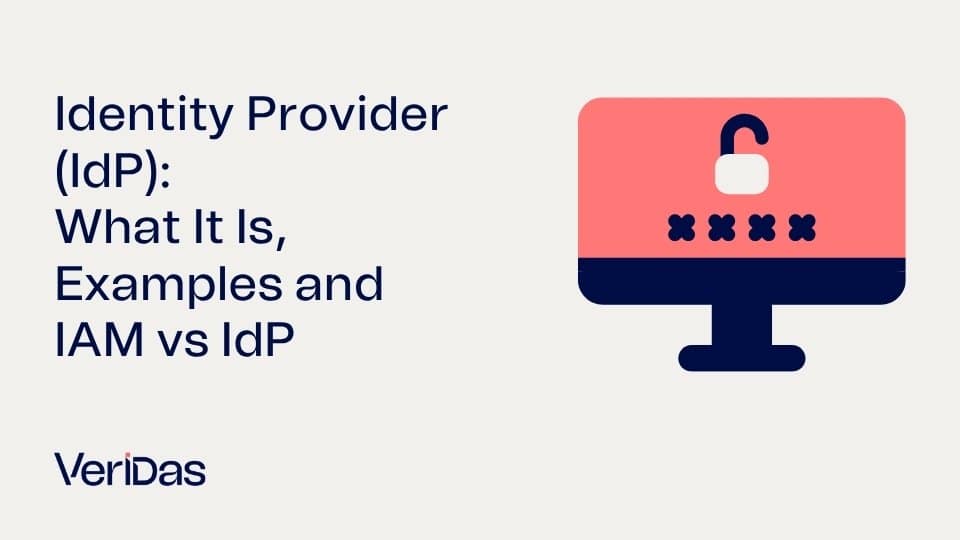
An identity provider is a centralized system that manages digital identities to verify users before granting access to applications. In an era where credential-based attacks are more sophisticated, an IdP acts as the single source of truth for your security infrastructure. By centralizing the authentication process, organizations ensure that only authorized individuals access sensitive corporate resources.
An IdP is the backbone of modern Identity and Access Management (IAM). It enables essential workflows such as Single Sign-On (SSO) and Multi-Factor Authentication (MFA) to reduce user friction. For companies leveraging Veridas, the IdP integrates advanced biometrics to replace vulnerable passwords with secure physical traits like face authentication and voice biometrics.

What Is an Identity Provider in Authentication?
An identity provider serves as the digital gatekeeper that authenticates a principal across a network. Instead of every application managing its own database of credentials, they delegate the verification to the IdP. This approach significantly reduces the attack surface by minimizing the locations where sensitive user data is stored.
The core role of an IdP is to provide authentication as a service to various Service Providers (SPs). When a user attempts to log in, the application redirects the request to the IdP for identity validation. Once verified, the IdP issues a digital token that informs the application that the user is legitimate and safe to proceed.
Identity providers are essential for implementing a Zero Trust architecture, where identity is continuously verified. By using a robust IdP, organizations can enforce strict security policies consistently across all cloud services and internal tools. This prevents a single compromised application from leading to a full-scale breach of the corporate environment.
Solutions like Veridas enhance the IdP role by adding a layer of 100% proprietary biometric technology. This shift moves authentication from knowledge-based factors (passwords) to inherence-based identity. This transition represents the highest standard of security available in the current market, protecting against sophisticated spoofing attempts.
How Identity Providers Work in Authentication Systems
The workflow of an identity provider relies on standardized protocols such as SAML, OpenID Connect (OIDC), and OAuth 2.0. When a user accesses a service, the service provider sends a request to the IdP to verify the user status. The user then provides their credentials—ideally biometric data—directly to the IdP, keeping them hidden from the application.
After confirming the identity, the IdP generates a cryptographically signed assertion containing user information. This token is sent back to the service provider, which validates the signature to ensure it comes from a trusted source. This entire handshake happens in milliseconds, providing a seamless experience while maintaining a high security posture.
One of the main benefits is the decoupling of the user store from individual applications. IT teams can manage the user lifecycle, such as onboarding and offboarding, in one central location. When an employee leaves the company, revoking their access in the IdP immediately locks them out of every connected service.
For high-security environments, the identity provider workflow can include adaptive authentication. If a login attempt appears suspicious, the IdP can trigger additional biometric challenges. Veridas facilitates this by offering liveness detection that ensures the person behind the screen is real and physically present during the event.
Identity Provider vs IAM: Key Differences
Understanding the distinction between an identity provider and Identity and Access Management (IAM) is crucial. IAM is the broad framework of policies that manage the entire identity lifecycle. In contrast, the IdP is a specific component within that IAM umbrella focused strictly on the act of authentication.
While an IAM system handles the “who, what, and how” of access, the IdP is primarily concerned with verifying the “who”. The IAM system uses the signals from the IdP to determine if a user has the correct permissions for a resource. You can think of the IAM as the security policy and the IdP as the verification tool.
What Is IdP vs IAM?
The difference lies in the scope: an identity provider validates credentials, while IAM defines the access strategy. IAM includes governance, auditing, and authorization policies that extend far beyond the initial login. The IdP provides the foundational trust upon which these broader rules are built and enforced.
Many organizations use a dedicated IdP for workforce management and a separate platform for customer identities. This allows for tailored security levels depending on the risk profile of the user. However, both systems must work in harmony to ensure there are no gaps in the digital security perimeter.
How IAM Uses Identity Providers
In a mature security stack, the IAM platform acts as an orchestrator that connects multiple identity providers. For example, a company might use Microsoft Entra ID for employees and a social IdP for external partners. The IAM system simplifies this by providing a unified interface for managing diverse identity sources.
Integrating Veridas into this flow allows IAM systems to receive high-assurance signals. The IAM platform can then make more confident authorization decisions based on verified biometric data. This integration is vital for meeting regulatory requirements in sectors like banking and government administration.
Examples of Identity Providers
There are several types of identity provider solutions, ranging from enterprise platforms to consumer social logins. Enterprise IdPs are designed for internal workforce management and offer deep directory integrations. Consumer IdPs focus on user experience and high-volume traffic for public-facing digital services.
Choosing the right example of an IdP depends on your security requirements and technical stack. Some companies prefer cloud-native providers for scalability and remote access. Others may require on-premises solutions to comply with specific data residency laws and internal security mandates.
Common Identity Providers Used by Companies
Microsoft Entra ID is one of the most widely used identity providers in the corporate world. It integrates natively with the Microsoft 365 suite and provides a robust foundation for hybrid cloud environments. Other popular choices include Okta and Ping Identity, which offer extensive integration catalogs.
Google Workspace also serves as a powerful IdP for many startups and tech-heavy organizations. These platforms allow employees to use one single set of credentials for all their tools. This centralization is the key to reducing password fatigue and improving the overall productivity of the digital workforce.
Most Popular Identity Authentication Services
In the consumer space, social identity providers like Google or Apple are dominant. These services offer frictionless onboarding for users who want to avoid creating new accounts. While convenient, they often lack the granular security controls required for high-risk business transactions.
For organizations needing both convenience and extreme security, Veridas offers a specialized authentication service. By using biometrics, Veridas acts as a high-assurance identity source within any IdP framework. This allows companies to provide a passwordless authentication experience that is far more secure than traditional methods.
Why Companies Need an Identity Provider
Implementing a dedicated identity provider is essential for modern business resilience. The primary driver is the alarming rate of credential-based attacks, such as phishing. An IdP helps mitigate these risks by enforcing stronger authentication and centralizing security monitoring in a single dashboard.
An IdP is also vital for managing the complexity of multi-cloud environments. Without a central hub, IT teams would have to manually manage accounts across dozens of siloed applications. This fragmentation leads to security gaps and increases the risk of former employees retaining access to sensitive data.
Compliance is another major factor for adopting an identity provider in regulated industries. Regulations like GDPR and PSD2 require strict controls over access to personal and financial information. An IdP provides the necessary audit logs and reporting tools to prove compliance with these legal requirements.
Finally, a robust IdP improves employee productivity by enabling Single Sign-On (SSO). When users can access all their tools with one secure login, they are less likely to use weak passwords. This creates a more efficient working environment where security does not come at the expense of usability.
Benefits of Using an IdP Authentication Service
The first major benefit is the drastic reduction in IT costs related to password resets. Password issues can account for up to 50% of help desk tickets, costing organizations significant resources. By implementing SSO through an IdP, you eliminate the primary cause of these support requests.
Another critical benefit is the automation of user provisioning. When a new hire is added to the central directory, the IdP automatically creates their accounts across all relevant apps. Conversely, when someone leaves, their access is revoked everywhere instantly, preventing potential data leaks.
An identity provider also enables Multi-Factor Authentication (MFA) at scale without frustrating users. Modern IdPs use adaptive MFA to only prompt for extra verification during high-risk events. This ensures that security is always present when needed but stays out of the way during normal activities.
For companies using Veridas, the benefit is the integration of world-class biometrics. This enables a truly passwordless future where users are recognized for who they are. This not only boosts security but also enhances brand reputation by providing a modern and frictionless user experience.
How to Choose the Right Identity Provider for Your Organization
Choosing the right identity provider requires evaluating your current and future needs. Ensure the IdP supports the standard protocols used by your most critical business tools. Also, consider the quality of technical support and documentation provided by the vendor for a smooth deployment.
Scalability is a vital factor for any growing organization. You need a platform that can handle an increasing number of users without degrading performance. Cloud-hosted IdPs are generally better for scaling quickly, but verify they meet your specific data residency requirements.
Security features should be at the top of your checklist, specifically support for advanced biometrics. Does the identity provider allow you to integrate third-party engines like Veridas for higher assurance? Ensure the platform has a proven track record of uptime and transparent security policies.
Finally, consider the total cost of ownership, including integration and maintenance. A cheaper IdP may end up costing more if it lacks essential security features or requires custom coding. Investing in a flexible and secure IdP is a strategic move that reduces long-term risk and operational overhead.
Use Cases by Industry
- Banking: Secure customer onboarding using biometric IdPs to prevent identity fraud in digital transactions.
- Telcos: Centralized management of partner access to sensitive network infrastructure and user databases.
- Insurance: Streamlining agent access to multiple underwriting platforms while ensuring strict regulatory compliance.
- Mobility: Fast verification of drivers and users across shared platforms using secure digital identity wallets.

Why Veridas Is the Best Choice for Identity Verification
Choosing Veridas as your identity partner means opting for a globally recognized leader in biometric accuracy. Our technology is consistently ranked among the top performers by NIST (National Institute of Standards and Technology), ensuring that your identity provider (IdP) is backed by world-class facial and voice recognition. This level of precision is vital for high-stakes environments where preventing identity fraud is a non-negotiable requirement.
One of our key differentiators is the 100% proprietary nature of our technology. Unlike many providers that rely on third-party black boxes, Veridas develops every algorithm in-house, allowing for full transparency and rapid adaptation to new threats like deepfakes. This end-to-end control ensures that our solution is not only more secure but also more agile in responding to evolving global regulations.
In the banking sector, Veridas has proven to be a catalyst for digital transformation, enabling 100% digital onboarding processes that comply with strict AML and KYC laws. Our solution reduces the time to open an account from days to less than a minute, significantly lowering abandonment rates. By balancing legal compliance with a frictionless user experience, we help financial institutions grow their customer base securely.
Furthermore, our commitment to privacy by design and ethical AI sets us apart from the competition. We use Renewable Biometric References (RBRs) to ensure that user data is protected and can be updated if a compromise is suspected. This forward-thinking approach ensures that your organization remains future-proof against emerging privacy mandates while maintaining the trust of your end users.