Artificial intelligence refers to the development of computer systems capable of performing tasks that normally require human intelligence. These functions include learning, reasoning, problem-solving, and perception.
Unlike traditional software that follows a rigid set of pre-defined rules, AI uses algorithms to identify complex patterns within vast datasets. This allows machines to make autonomous decisions based on the information provided.
In today’s digital landscape, AI is the engine behind many of the technologies we use daily. It enables everything from personalized movie recommendations to high-precision biometric security systems used by global organizations.
For Veridas, artificial intelligence is the core of our identity verification solutions. We use it to ensure that digital interactions are secure, private, and accessible to everyone, everywhere in the world.

How does AI work?
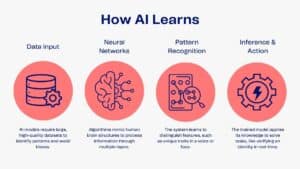
Artificial intelligence works by combining large amounts of data with fast, iterative processing and highly intelligent algorithms. This combination allows the software to learn automatically from features in the data.
The foundation of most modern AI is machine learning. This process involves training a model on a specific dataset so it can recognize patterns and make accurate predictions when presented with new, unseen information.
Data is the most critical component in this process. AI models require diverse and high-quality data to avoid biases and ensure they can perform reliably in real-world scenarios across different demographics.
Neural networks are another key element, designed to mimic the structure of the human brain. These networks consist of layers of nodes that process information and pass it along, refining the result at each stage.
Once an AI model is trained, it undergoes a phase called inference. In this stage, the model applies what it has learned to solve a problem, such as identifying a face or translating a sentence.
Computing power is also essential for AI to function. Modern processors allow models to perform the millions of mathematical calculations required to process complex data, like high-resolution video, in real-time.
Feedback loops are often used to improve the system. If the AI makes an error, the model can be adjusted to reduce the margin of error in future attempts, leading to continuous performance gains.
In the field of biometrics, AI works by extracting unique features from a physical trait, such as a voice or a face. These features are then converted into a digital mathematical template for secure comparison.

Types of artificial intelligence
Understanding the different types of artificial intelligence is vital for any organization looking to implement these tools. Not all AI is designed for the same purpose or has the same capabilities.
The scientific community generally classifies AI into three main categories based on their level of intelligence. These range from specialized tools to theoretical systems that could surpass human cognitive abilities.
Most AI applications currently available on the market fall into the first category. While they may seem highly intelligent, they are limited to a very specific range of tasks and operational parameters.
By categorizing AI, we can set realistic expectations about what the technology can achieve today. It also helps us prepare for the legal and ethical challenges that future developments might bring to society.
At Veridas, we focus on developing high-performance specialized AI. This ensures our technology remains reliable and secure for critical applications like banking, telecommunications, and government identity services.
Classification according to functionality
Functional classification looks at how an AI system manages data and its ability to generalize knowledge. This is a technical perspective used to measure the evolution of machine intelligence over time.
This classification moves from simple systems that only react to their environment to complex models that could potentially have their own thoughts. We are currently at the early stages of this journey.
The following subsections provide a detailed look at the three levels of functionality. Each level represents a significant milestone in the history and future of computer science and algorithmic research.
Narrow AI (ANI)
Artificial Narrow Intelligence (ANI) is designed to perform a single task with high efficiency. It is often called “Weak AI,” although it can be much faster and more accurate than a human in its domain.
ANI is the only type of AI that exists today. It powers the facial recognition on your phone, the spam filter in your email, and the voice biometrics used by Veridas to authenticate users securely.
These systems cannot transfer their knowledge to a different task. An AI trained to recognize identity documents cannot play chess or understand a conversation about the weather unless specifically trained for it.
The strength of ANI lies in its focus. Because it is built for a specific purpose, it can be optimized for maximum security and performance, which is essential for protecting digital identities against fraud.
Narrow AI is already transforming the global economy. It allows companies to automate repetitive tasks and provide 24/7 service without the limitations of human fatigue or the risk of manual errors.
General AI (AGI)
Artificial General Intelligence (AGI) refers to a machine that could learn and understand any intellectual task that a human can. It would be able to apply its intelligence across multiple different fields.
An AGI system would possess common sense, the ability to plan, and the capacity to reason about abstract concepts. It would not be restricted to the narrow datasets that current AI models depend on.
Currently, AGI is a theoretical concept. While some modern language models show signs of generalized knowledge, they still lack the deep understanding and independent consciousness required to be considered true AGI.
The development of AGI would be a turning point in human history. It would allow machines to solve complex global problems, such as climate change or disease, by integrating knowledge from many scientific disciplines.
Many experts believe that we are still decades away from achieving AGI. The technical hurdles, such as creating machines that understand context and nuance like humans do, remain incredibly difficult to overcome.
Superintelligent AI (ASI)
Artificial Superintelligence (ASI) is a hypothetical level of AI that would be smarter than any human in every possible way. This includes social skills, general wisdom, and scientific creativity.
ASI would not just be faster than a human; it would be able to think in ways that are beyond our comprehension. It could potentially invent new technologies or theories that humans could never discover.
The idea of ASI raises many ethical and safety concerns. If a machine becomes significantly smarter than its creators, ensuring that its goals remain aligned with human values would be a critical challenge.
For now, ASI remains in the realm of science fiction and philosophical debate. There is no existing technology or scientific path that leads directly to the creation of a superintelligent machine in the near future.
What are the 10 most common types of AI?
The practical application of AI in the industry has led to the emergence of specific types of tools. These technologies are often used in combination to solve complex business problems and improve efficiency.
The following list highlights the most common types of artificial intelligence you will encounter in the modern professional world. Each one plays a unique role in the current digital transformation.
- Machine Learning: Systems that learn and improve from data patterns over time.
- Deep Learning: Neural networks with many layers used for complex image and voice data.
- Natural Language Processing (NLP): AI that understands and generates human language.
- Computer Vision: Technology that enables machines to interpret and analyze visual information.
- Generative AI: Models that create new content, such as text, images, or synthetic data.
- Predictive Analytics: Using data to forecast future events or trends with high accuracy.
- Reinforcement Learning: Training AI through a system of rewards and penalties in simulations.
- Expert Systems: Programs that emulate the decision-making of a human expert in a field.
- Robotics: Integrating AI into physical machines to automate complex manual maneuvers.
- Virtual Assistants: AI that interacts with users through natural language to perform tasks.
These tools are currently helping industries like healthcare, finance, and logistics to operate more effectively. At Veridas, we specialize in computer vision and voice biometrics to provide top-tier security.
What are the 4 main types of AI?
Another popular way to categorize AI is based on its psychological complexity. This model, proposed by researcher Arend Hintze, divides AI into four types that represent its evolutionary path.
| Type | Key Characteristic | Practical Example |
|---|---|---|
| Reactive Machines | No memory of the past. | Deep Blue (Chess AI) |
| Limited Memory | Learns from recent data. | Self-driving cars |
| Theory of Mind | Understands human intent. | Advanced research models |
| Self-Awareness | Has its own consciousness. | Theoretical future AI |
Reactive machines are the most basic form of AI. They cannot store memories or use past experiences to make current decisions. They simply react to the input they receive in the present moment.
Limited memory AI is the most common type today. These systems can store some historical data to inform their decisions, which is how modern facial recognition systems distinguish between a real person and a photo.
Real-world applications of artificial intelligence
Artificial intelligence is no longer a futuristic concept; it is already integrated into the fabric of our society. Its applications are broad and touch almost every aspect of our daily and professional lives.
In the financial sector, AI is used to detect fraudulent transactions in real-time. By analyzing millions of data points per second, it can stop identity theft and protect the assets of millions of customers.
Healthcare is another major field for AI. Algorithms can now analyze medical images to identify signs of illness much faster than humans, leading to earlier diagnoses and more effective treatments for patients.
In the retail industry, AI-powered recommendation engines personalize the shopping experience. These systems learn from your past behavior to suggest products that are most likely to meet your needs and preferences.
The world of identity verification has been transformed by AI. At Veridas, our technology allows users to verify their identities using their voice or face, making physical IDs and passwords less necessary.
Transportation is also seeing a revolution thanks to AI. Beyond autonomous vehicles, AI is used to optimize global supply chains and manage urban traffic flow to reduce travel times and carbon emissions.
Benefits and challenges of AI
The benefits of AI are numerous, including increased productivity, improved accuracy, and the ability to solve problems at a scale that was previously impossible for human teams to handle alone.
AI can also take over dangerous or repetitive tasks, allowing humans to focus on more creative and high-value work. This shift can lead to more fulfilling careers and a more efficient global economy.
However, the technology also brings significant challenges. One of the most important is the risk of bias, where AI systems can perpetuate unfairness if the data they are trained on is not balanced.
Privacy is another major concern. As AI systems require vast amounts of data to function, ensuring that this information is handled ethically and in compliance with regulations like GDPR is a top priority.
The rise of deepfakes and AI-generated misinformation is another challenge. This requires new security solutions, such as those developed by Veridas, to verify the authenticity of digital content and identities.
Finally, there is the question of the future of work. As AI automates more tasks, society must focus on reskilling the workforce to ensure that everyone can participate in the new AI-driven economy.
Veridas
Veridas is a leading company in the field of AI-driven biometrics and digital identity. We believe that technology should be used to protect people and simplify their interactions with the digital world.
Our solutions are built on 100% proprietary technology. This allows us to have full control over the security and ethics of our algorithms, ensuring that they are transparent, fair, and highly reliable.
We work with some of the world’s largest companies in banking, insurance, and telecommunications. Our goal is to help them eliminate fraud and provide a seamless experience for their customers through AI.
At Veridas, we are committed to the responsible use of AI. We follow a “Privacy by Design” approach, ensuring that user data is protected from the very first step of our development process.
Our technology is not just about security; it is also about accessibility. By using voice and facial biometrics, we make it easier for everyone, including the elderly and people with disabilities, to access digital services.
As the field of artificial intelligence continues to grow, Veridas will remain at the forefront. We are constantly innovating to meet new security challenges and provide the most advanced identity solutions on the market.
We believe in a future where you are your own key. By leveraging the power of AI, we are making that future a reality today, creating a world where identity verification is fast, secure, and respectful of privacy.
Use Cases by Industry
- Banking: Secure digital onboarding with document verification and facial biometrics to reduce fraud and operational costs.
- Insurance: Automated “proof of life” checks using voice biometrics, improving accessibility for senior citizens.
- Telecommunications: Preventing identity theft in SIM card activations through real-time biometric validation of the subscriber.
- Mobility: Verifying the identity of drivers in car-sharing services to ensure safety and regulatory compliance without manual intervention.

Frequently Asked Questions (FAQ)
What is artificial intelligence in simple terms?
How many types of AI exist today?
Is AI safe for my personal data?
Can AI replace humans in the workplace?