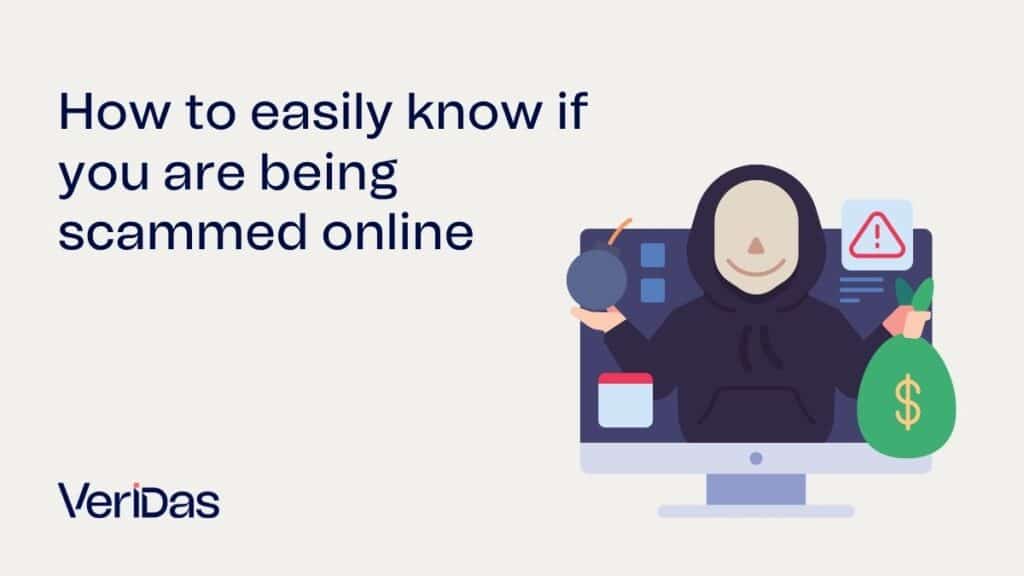
Learning how to know if I am being scammed is a basic digital survival skill for any user today. Online fraud is evolving with the use of artificial intelligence, facilitating deceptions that were previously detectable at a glance but are now almost imperceptible.
This article offers a factual guide to identifying suspicious behavior and unusual data requests. Understanding the mechanisms of fraud allows for preventive action, protecting both financial information and the integrity of personal identity within the global digital ecosystem.
Our technology at Veridas demonstrates that modern biometrics is the most effective tool to combat these threats. By focusing on real identity rather than transferable credentials, the traditional vulnerabilities that scammers successfully exploit every day are eliminated.
To protect yourself effectively, it is vital to recognize red flags immediately. Below, we detail the key indicators that usually precede a fraud attempt and the necessary measures to secure your digital environment in a robust and permanent way.

Signs that you might be getting scammed
Identifying a fraud attempt in time is fundamental to avoiding serious economic consequences. Scammers often use urgency or fear to cloud the victim’s judgment, forcing quick decisions without proper verification of the original source.
A clear sign is the receipt of unsolicited communications demanding immediate action. These messages often come from seemingly legitimate entities but contain subtle errors in the sender’s address or links that redirect to websites whose structure is not official.
Inconsistency in the information provided is another clear sign of deception. If an offer seems too attractive or if the terms of a service suddenly change under vague pretexts, it is most likely a designed social engineering maneuver.
The use of unconventional payment methods should also raise immediate suspicion. Legitimate companies rarely request transfers via gift cards, cryptocurrencies, or instant money transfer services to resolve technical issues or outstanding debts.

Suspicious behavior in emails and messages
Fraudulent emails often feature excessively formal language or, conversely, are riddled with spelling mistakes. These messages attempt to mimic the visual identity of banks or public institutions but fail on technical details that a trained eye can detect.
It is common to observe that the name shown in the sender field does not match the actual email address. By hovering over a link before clicking, you can verify if the destination URL truly corresponds to the official domain of the mentioned organization.
Many vishing attacks now use synthetic or cloned voices to gain trust. These calls usually create a false sense of crisis, such as an unauthorized charge on the account, to trick the user into revealing security codes or impulsively authorizing transactions.
Liveness detection is the technology that allows distinguishing between a real human interaction and pre-recorded or synthetic media. At Veridas, our solutions detect these presentation attacks to ensure that only the legitimate person can access their services or financial assets.
Unclear offers or requests
Scams are often disguised as unique investment opportunities with guaranteed returns. Any request for initial capital promising extraordinary profits without risk should be treated as potential fraud, as financial markets operate under transparency criteria.
Unsolicited technical help requests are another recurring tactic. Supposed support agents call reporting non-existent viruses on the computer to gain remote access to the device, thus allowing the theft of banking credentials and access to sensitive personal information.
Lottery or unexpected prize fraud always requires a prior payment for fees or taxes. Remember that no legitimate entity conditions the delivery of a legitimate prize on the prior payment of amounts of money by the beneficiary to unknown accounts.
To mitigate these risks, organizations must implement robust identity verification processes. The use of facial and voice biometrics ensures that the person in the interaction is who they claim to be, eliminating the risk derived from stolen passwords.
Data that scammers usually ask for
The primary goal of any cybercriminal is to obtain information that allows them to monetize the deception. Understanding how to know if you are being scammed online involves knowing which data is critical and why a trusted entity would never request it through open channels.
Attackers primarily look for credentials that give them direct access to financial funds. This includes card numbers, expiration dates, and, most importantly, the CVV code, which is the final key to performing unauthorized transactions in any e-commerce store.
There is also great interest in identity data that allows for complete impersonation. National identification numbers, such as a DNI or driver’s license, are used to open fraudulent accounts or apply for loans in the defenseless victim’s name.
Our Veridas CORE solution allows for the automatic validation of the authenticity of these documents in seconds. This prevents scammers from using tampered or forged documents to bypass security controls in new customer onboarding or financial service processes.
| Data Type | Legitimate Request | Fraudulent Request |
|---|---|---|
| Passwords | Never requested by staff | Requested by phone or email |
| SMS/OTP Code | Entered only on the official web | Requested to “cancel” an error |
| Card PIN | Exclusive use in physical terminals | Required to verify identity |
| ID Document | Processed via guided capture/NFC | Photo sent via chat or email |
Personal and financial information
Financial data is the most coveted asset on the dark web. Scammers use fake payment pages that look identical to real banking gateways, capturing in real-time every digit the victim enters under the false belief of making a purchase.
Personal information, such as address or relatives’ names, is used to personalize future attacks. This tactic, known as spear phishing, considerably increases the effectiveness of the deception by making the message appear much more credible and specifically directed at the user.
Synthetic identity theft is a growing threat that already represents 85% of financial fraud cases according to our reports. Criminals mix real data with fabricated information to create new profiles that are difficult to detect with traditional verification methods.
Veridas technology combats this industrialization of fraud through advanced injection attack detection. We verify the integrity of the device to ensure that emulators or virtual cameras are not being used to inject fake data into the validation system.
Passwords and security codes
No employee of a bank or official technical service will ever ask for a password over the phone. Passwords are personal and non-transferable knowledge factors, and requesting them is always an irrefutable indicator that you are facing a scam attempt.
Codes sent by SMS (OTP) are frequently intercepted through social engineering. The scammer convinces the victim that the code received is to block a supposed attack, when in reality it is the necessary key to authorize an outgoing transfer already initiated.
Multi-factor authentication (MFA) based on biometrics eliminates dependency on these shared secrets that are so easy to steal. By requiring “something you are,” such as your face or voice, a layer of security is established that is virtually impossible to compromise.
At Veridas, we offer a vision of a future without passwords or keys. Our technology allows people to be recognized privately and voluntarily for who they are, guaranteeing their right to use their real identity in any physical or digital environment in the world.
Most common types of fraud
The digital threat landscape is diverse and adapts quickly to new consumption habits. Knowing the most frequent methods allows you to stay alert and apply appropriate protection measures before economic damage becomes irreversible for the user.
Phishing remains the king of techniques due to its low cost and high scalability. However, we are seeing a transition toward more sophisticated attacks that use generative artificial intelligence to create hyper-realistic content that deceives even the oldest and most obsolete security systems.
E-commerce fraud has increased proportionally with the growth of digital shopping. Fake stores and scams on second-hand platforms exploit buyer confidence to obtain banking data or payments for products that will never be shipped.
Organizations must adopt a Zero Trust approach. This model assumes that any access request could be malicious and requires continuous verification of identity and the device, regardless of whether the user is within the corporate network.
- Always verify the official domain of the URL before entering data.
- Do not share verification codes received by SMS with third parties.
- Use recognized payment gateways and avoid direct transfers.
- Distrust messages with spelling errors or an urgent tone.
- Activate biometric two-factor authentication whenever available.
Email scams and phishing
Traditional phishing has given way to smishing (via SMS) and vishing (via voice). All share the same goal: redirecting the user to a fraudulent page to capture their data or convincing them to perform an action that compromises their immediate financial security.
Current phishing emails use SSL certificates to show the security padlock in the browser. This technique seeks to deceive the user into believing the site is secure, when in reality it only means the communication is encrypted, not that the destination is legitimate.
Business Email Compromise (BEC) attacks target employees with the capacity to make payments. By impersonating an executive, criminals request urgent transfers to accounts controlled by them, causing millions in losses to companies within minutes.
Our Voice Shield solution analyzes the voice in milliseconds to detect if it is a deepfake or a recording. This technology allows contact centers to secure every interaction, blocking synthetic voices before they can consummate identity theft fraud.
Fraud in online buying and selling
Fraudulent online stores often use excessively low prices to attract victims. After payment is made, the site disappears, and the user discovers their card data has been stolen to perform additional unauthorized charges on other global sales platforms.
On peer-to-peer marketplace platforms, the scammer usually requests to continue the conversation outside the official application. This allows them to send fake payment links that mimic the platform’s aesthetics but actually capture the seller’s banking information.
Refund fraud is another tactic affecting legitimate sellers. The buyer claims the product hasn’t arrived or sends back an empty box, abusing consumer protection policies to keep both the item and the transaction money.
To prevent these frauds, it is essential to verify the real identity of users at the time of registration. The integration of Veridas into onboarding flows ensures that there is a real person behind every profile, drastically reducing the creation of fake accounts.
Identity theft
Identity theft occurs when someone uses your personal data without permission to commit fraud. This can have long-term consequences, such as inclusion in credit blacklist files or legal problems for criminal activities carried out under the defenseless victim’s name.
Video deepfakes are the final frontier in identity theft. Using AI, attackers create faces that perfectly mimic the movements and expressions of a real person, attempting to bypass conventional facial recognition systems during identity verification processes.
Our presentation attack detection (PAD) technology is certified at iBeta Levels 1 and 2. This guarantees that our solutions can detect everything from photos shown on a screen to high-quality 3D masks, ensuring that only real users gain access.
Furthermore, the use of Renewable Biometric References (RBRs) protects user privacy. By transforming the face into an irreversible and non-interoperable mathematical vector, we ensure that even in the unlikely event of a database breach, the information is useless to the attacker.
What to do if you suspect a scam
If you feel that learning how to know if I am being scammed has come too late and you have already interacted with an attacker, acting quickly is vital. Time is the most important factor in mitigating damage and allowing authorities and financial entities to intervene successfully.
The first action should always be to contact your bank to block compromised cards and accounts. Most banks have 24/7 emergency services specifically designed to manage situations of possible fraud or theft of access credentials.
Changing all passwords for your digital services is the next necessary step. If you use the same key on multiple platforms, the attacker might be trying to access your social networks or email through credential stuffing attacks after obtaining initial access.
Organizations using our Veridas NEXUS technology allow their users to manage their identity sovereignly. This digital wallet stores credentials encrypted on the user’s device, allowing access to be revoked instantly in case of loss or suspected compromise.
Immediate protection measures
Review your recent bank movements for small or unknown transactions. Scammers often perform low-amount charges to verify that the card is still active before proceeding to a massive withdrawal of funds that empties the available balance.
Deactivate any remote access you may have granted to a third party. If you allowed someone to enter your computer under a false pretext of technical support, it is essential to disconnect the device from the internet and perform a deep system clean to remove potential spyware.
Inform your close contacts about the situation to prevent them from being the next victims. Attackers often use stolen email accounts or messaging apps to ask relatives for money, exploiting the bond of trust already established with the account holder.
Activating biometric authentication on all applications that allow it offers superior protection. Unlike an SMS code, your face or voice cannot be intercepted during transmission, guaranteeing that you are the only one capable of authorizing critical operations.
How to report fraud
Filing a report with law enforcement is an indispensable requirement for any subsequent claim. The police report serves as official evidence for the bank and insurance companies to start the recovery process for funds stolen by the criminal.
Gather all possible evidence, including screenshots, emails, and phone numbers from which you were contacted. This information is crucial for cybercrime units to track the origin of the attack and dismantle organized fraud networks.
Notify the incident to national consumer protection and cybersecurity agencies. These entities use user reports to generate early warnings that protect the entire community and improve best practice guides to prevent future massive deceptions.
At Veridas, we collaborate closely with regulators and governments to define the standards for the digital identity of the future. Our commitment is to develop responsible technology made in Europe that protects people’s fundamental rights against the growing threats of the digital world.
Use cases by industry
- Banking and Insurance: Implementation of digital onboarding with Identity Verification (IDV) to reduce fraud in account opening and remote policy contracting.
- Telecommunications: Instant activation of SIM cards and contract signing through voice biometrics, improving customer experience and eliminating the risk of fake identities.
- Mobility: Driver registration for vehicle rentals in less than a minute through automatic driver’s license validation and facial biometric comparison.
- Events and Sports: “Hands-Free” biometric access control in stadiums that eliminates physical tickets and prevents scalping, ensuring only authorized persons enter the venue.