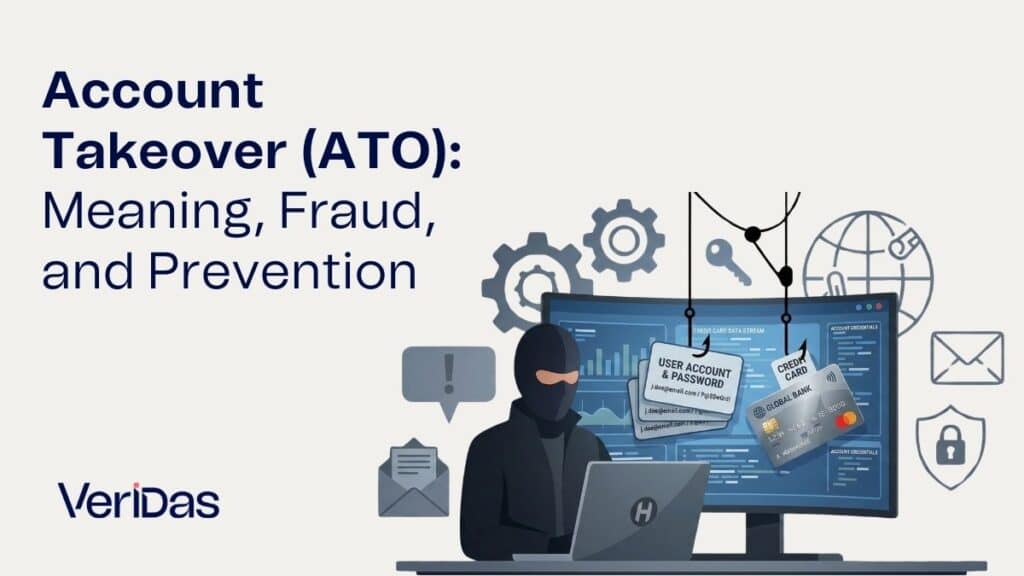
Account takeover is a severe form of identity theft where a malicious actor gains unauthorized access to a user’s account. This cyberattack allows criminals to change credentials, steal sensitive data, or perform fraudulent transactions. It is one of the most persistent threats to online businesses and their customers today.
The impact of these attacks extends beyond financial loss for the victim and the organization involved. Companies often face long-term reputational damage and a significant loss of customer trust after a breach occurs. Understanding the mechanics of these threats is the first step toward building a robust defense system.
Preventing these incidents requires a shift from traditional security methods like passwords to more advanced solutions. Veridas provides cutting-edge biometric technology designed to stop unauthorized access before it happens. Our focus is on creating a secure environment that does not compromise the user experience.
This guide explores the meaning of ATO, how attacks work, and the latest detection and prevention strategies. We will examine why biometric authentication is becoming the global standard for protecting digital identities. Stay informed to safeguard your business and your users from evolving fraud techniques.
What Is Account Takeover?
An account takeover happens when a fraudster successfully bypasses security measures to control a legitimate account. Once inside, the attacker acts as the real owner to exploit the account’s value or access. This can involve draining bank accounts, making unauthorized purchases, or stealing personal information for further crimes.
The rise of automated tools has made it easier for criminals to execute these attacks at a massive scale. They use bots to test millions of stolen credentials across various platforms until they find a match. This industrialization of fraud makes traditional perimeter defenses less effective than they were in the past.
Organizations across all sectors, from finance to retail, are targets for these sophisticated criminal operations. The goal is often immediate financial gain, but sometimes the objective is to gather data for future identity theft. Regardless of the motive, the result is always a violation of the user’s privacy and security.
To effectively combat this, businesses must implement multi-layered security protocols that identify users accurately. Veridas helps organizations replace vulnerable entry points with secure, face-based authentication systems. This approach ensures that only the rightful owner can access their sensitive digital assets.

What Does Account Takeover Mean?
In the context of cybersecurity, the term refers to the complete hijacking of a digital relationship. It means the attacker has effectively stolen the digital persona of a customer within a specific service. This allows them to lock out the real owner and operate with total impunity for a period.
The meaning of account takeover also encompasses the failure of traditional authentication methods like passwords. If a static code is all that stands between a criminal and an account, the risk of breach is high. Modern security philosophy assumes that credentials will eventually be leaked or stolen by hackers.
Therefore, meaning also implies a transition toward zero trust models where identity is constantly verified. It is no longer enough to trust a user just because they have the correct login and password. Security teams now look for physiological traits that are unique to the individual and impossible to replicate.
At Veridas, we believe the meaning of security should be synonymous with simplicity and absolute certainty. Our technology ensures that your face is your key, removing the risk of credential-based hijacking entirely. This redefines how businesses interact with their customers in an increasingly dangerous digital world.
How Account Takeover (ATO) Attacks Work
An account takeover attack typically begins with the acquisition of user credentials through various illegal methods. Hackers may buy databases on the dark web or use social engineering to trick users into revealing info. Once they have a potential lead, they attempt to log in to the targeted platform.
If the system only requires a password, the attacker gains full access almost instantly and begins their activity. They often change the email address or phone number associated with the account to prevent recovery by the owner. This “locking out” phase is critical for the fraudster to maximize their time inside the system.
Advanced attackers may also use session hijacking to take over an account that is already logged in. By stealing browser cookies, they can bypass even some forms of two-factor authentication that rely on one-time codes. This demonstrates why physical presence and biometric verification are becoming essential for high-risk actions.
Veridas mitigates these risks by requiring a live biometric check for sensitive transactions or logins. Our systems can detect if a person is physically present or if an attacker is using a photo or video. This layer of protection stops the attack cycle at its most vulnerable point: the moment of entry.
Common ATO Hacking Techniques
One of the most frequent methods is credential stuffing, where bots use leaked passwords from other sites. Since many people reuse passwords, a breach at one company can lead to takeovers at many others. This technique is highly effective due to the massive volume of automated login attempts.
Phishing remains another top threat, where deceptive emails or texts lure users to fake login pages. These pages look identical to the real site, capturing the user’s details as they type them in. It is a psychological game that exploits human trust and urgency to gain unauthorized access.
Brute force attacks involve software that systematically tries every possible combination of characters to guess a password. While more time-consuming than other methods, it still succeeds against short or simple passwords. Systems without lockout policies are particularly vulnerable to this type of persistent mechanical guessing.
Veridas eliminates the effectiveness of these techniques by removing the need for passwords altogether. When there is no password to steal, phish or guess, the primary tools of the hacker become useless. Our face authentication solution provides a barrier that no bot or social engineering tactic can easily overcome.
Account Takeover Identity Theft
When an account takeover leads to identity theft, the consequences for the victim can last for years. Criminals use the stolen account to open new lines of credit or commit crimes in the victim’s name. This creates a complex legal and financial mess that is difficult and expensive to resolve.
In these cases, the hijacked account serves as a “foot in the door” for more damaging activities. The attacker may access tax records, medical history, or legal documents stored within the compromised service. This depth of information allows them to build a highly convincing false identity for other frauds.
Protecting against this requires more than just reactive monitoring; it requires proactive identity verification. Veridas ensures that the person accessing the account is the same person who originally opened it. By linking the digital account to a unique physical face, we provide a permanent anchor for identity.
Our solutions prevent the industrialization of identity theft by making it impossible for criminals to scale their efforts. Each verification requires a unique, live human face, which bots cannot provide or simulate effectively. This protects the individual’s long-term digital health and the integrity of the organization’s user base.
Account Takeover Fraud (ATO Fraud)
The term account takeover fraud describes the specific financial crimes committed after gaining access. This includes transferring funds, purchasing goods, or redeeming loyalty points that have monetary value. It is a direct attack on the financial assets of both the customer and the business.
Fraudsters often target accounts with stored payment methods, such as credit cards. They may make small “test” purchases to see if they are detected before attempting larger transactions. This stealthy approach allows them to drain significant value before the owner notices any suspicious activity. Account takeover fraud often acts as a gateway to broader payment fraud schemes. Once an attacker has control, they can exploit stored credit cards or linked bank accounts to execute unauthorized transactions.
For businesses, the cost of fraud includes chargeback fees, lost inventory, and high operational costs for investigations. There is also the hidden cost of increased friction if the company adds cumbersome security steps in response. Balancing security with a smooth user experience is the primary challenge for modern digital enterprises.
Veridas solves this by offering a secure and frictionless way to authorize high-value transactions. Instead of sending a code that can be intercepted, we ask the user for a quick facial scan. This prevents account takeover fraud while actually making the process faster and easier for the legitimate customer.
What Is Account Takeover Fraud?
At its core, it is the exploitation of a compromised digital relationship for illicit economic gain. It differs from new account fraud because the attacker is using a pre-existing, trusted profile. This makes it harder to detect because the activity may initially look like normal user behavior.
The fraud occurs when the system fails to distinguish between the legitimate user and the unauthorized intruder. If the authentication process only checks for “what you know” (passwords), it cannot verify “who you are.” This fundamental gap in security is what criminals exploit to commit their crimes.
Combatting this requires behavioral analysis combined with strong biometric verification at critical moments. Veridas provides the tools to confirm identity with total certainty during the most sensitive parts of the journey. This ensures that the trust established with the customer is never misused by a third party.
Our technology detects deepfakes and presentation attacks, ensuring that the biometric data is real and live. This level of security is essential in an era where AI can generate convincing fake images and voices. We provide a shield against the most sophisticated forms of modern digital deception and fraud.
Red Flags of an Account Takeover Attack
Detecting an account takeover early requires monitoring for specific “red flags” or anomalies in behavior. Common indicators include sudden changes to contact information, such as a new email address or phone number. These changes are often the first step an attacker takes to secure their control.
Multiple failed login attempts followed by a successful one from a new device or location is another warning sign. Unusual transaction patterns, like a sudden large purchase or a transfer to a new bank, should also trigger alerts. These behavioral shifts are often the only visible signs that a breach has occurred.
Users may also report receiving security codes they didn’t request or being unable to log in themselves. These reports are late-stage indicators that an attack is already in progress or has been completed. A proactive system should catch these anomalies before the user even realizes there is a potential problem.
Veridas enhances detection by providing an irrefutable proof of identity that bypasses behavioral guessing. When a red flag is raised, our system can challenge the user to provide a biometric verification. This immediately clarifies whether the activity is legitimate or a malicious attempt at a takeover.
Account Takeover Detection
Effective account takeover detection relies on a combination of technical signals and user behavior analysis. Systems look at IP addresses, device fingerprints, and geolocation to identify logins that deviate from the norm. However, sophisticated attackers can use proxies and VPNs to mimic the user’s typical environment.
This is why static detection methods are no longer sufficient to protect high-value digital accounts. Detection must be continuous and integrated into the entire lifecycle of the user’s session, not just at login. Monitoring for changes in navigation speed or typing patterns can provide additional clues of bot activity.
The goal of detection is to identify the intruder as quickly as possible to minimize the damage they can cause. Once a suspicious event is identified, the system must have a clear path for remediation or verification. This often involves stepping up the authentication requirements to a more secure level.
Veridas provides the ultimate detection tool: the human face and voice as a unique identifier. By integrating our biometric engine, companies can instantly verify if the person behind the screen is the owner. This turns detection from a game of probability into a process of absolute certainty and security.
ATO Fraud Detection Technologies
Modern detection platforms use machine learning to analyze millions of data points in real time. These systems can identify complex patterns of fraud that would be impossible for a human to spot. They look for similarities across different attacks to block known criminal infrastructures and botnets.
Device intelligence is also crucial, as it identifies the specific hardware used to access an account. If a device has been associated with fraud elsewhere, it can be blacklisted or flagged for extra scrutiny. This creates a global network of intelligence that helps protect all participants from known threats.
However, technology alone cannot stop a determined human attacker who has successfully phished a user’s details. The final line of defense must always be a verification step that the attacker cannot bypass with software. This is where biometric authentication becomes the most powerful tool in the detection arsenal.
Veridas technology integrates seamlessly with existing fraud detection platforms to provide that final verification. When a system flags a login as “high risk,” our Face Authentication serves as the definitive test. This prevents account takeover without requiring a manual review by a fraud analyst or agent.
Monitoring and Detection Best Practices
Companies should implement a multi-layered approach that includes both automated monitoring and user-facing security features. Regularly auditing account logs for unusual activity can help identify breaches that were missed in real time. Education is also key, as users need to know how to spot and report suspicious activity.
Another best practice is to require re-authentication for any change to sensitive account settings or data. This ensures that even if an attacker gets in, they cannot easily lock out the original owner. Using out-of-band verification, like a biometric check on a mobile app, adds a significant layer of difficulty.
Setting up alerts for users whenever their account is accessed from a new device provides an early warning system. This transparency builds trust and allows the user to act as an additional layer of detection for the company. Collaboration between security and customer service teams is essential for a fast and effective response.
Veridas supports these best practices by making re-authentication fast and simple for the legitimate user. Instead of waiting for an SMS code, the user just looks at their camera for a second to confirm. This encourages compliance with security policies while maintaining a high level of convenience and user satisfaction.
ATO Prevention Tools and Controls
The most effective prevention tool for account takeover is the elimination of shared secrets like passwords. Replacing them with public-key cryptography and biometrics creates a system where there is nothing for a hacker to steal. This shift fundamentally changes the economics of cybercrime by making attacks much harder.
Rate limiting and CAPTCHAs can help slow down bot-driven brute force and credential stuffing attempts. While useful, these are often just hurdles that sophisticated attackers can eventually overcome with enough resources. They do not address the root cause of the problem, which is the reliance on weak credentials.
Implementing WebAuthn and FIDO2 standards allows businesses to use the built-in biometric sensors on modern devices. This provides a standardized and secure way to verify identity across different browsers and operating systems. It is a major step toward a world where passwords are a thing of the past.
Veridas goes a step further by providing a proprietary biometric engine that is not tied to a specific device. This means a user can be authenticated on any camera-equipped device, providing more flexibility and security. Our tools are designed to stop account takeover at scale while improving the bottom line.
How to Respond to an Account Takeover
If an account takeover is confirmed, the first priority is to secure the account and prevent further damage. This involves immediately disabling the attacker’s access and resetting all authentication factors for the user. The company must also investigate which data or assets were accessed during the breach.
Notifying the affected user is a critical legal and ethical requirement in many jurisdictions under laws like GDPR. The communication should be clear, providing steps on how the user can protect themselves and restore their account. Transparency during this process is vital to maintaining whatever trust remains with the customer.
The response should also include a thorough “post-mortem” analysis to understand how the attacker gained access. This insight is used to close security gaps and prevent similar incidents from happening to other users in the future. Continuous improvement is the only way to stay ahead of the evolving tactics of fraudsters.
Veridas helps companies recover from these incidents by providing a secure way to re-verify identity. Using our document verification and face matching, users can prove they are the rightful owner and regain access. This automated process is faster and more secure than manual identity checks by support staff.
In conclusion, preventing an account takeover requires a move toward biometric identity that is both secure and convenient. By removing passwords and using face or voice authentication, businesses can protect their users and their reputation. Veridas is your partner in building a future free from the fear of identity theft.
Authenticate customers instantly and securely with facial recognition. Eliminate passwords and prevent account takeover while improving user convenience. Use our Face Authentication to let customers access their accounts with a selfie, requiring no passwords or codes. Deliver a fast, frictionless experience while protecting against unauthorized access.
Prevent account takeovers with secure face, voice, and wallet authentication and improve user experience. Our technology ensures that your organization stays ahead of fraud trends while meeting all regulatory compliance standards. Join the global leaders who trust Veridas to protect their most valuable digital assets and relationships.
Use Cases by Industry:
In the Banking sector, our technology secures mobile logins and authorizes high-value wire transfers to prevent fraud. For Telcos, it stops SIM swapping attacks by requiring a biometric check before any sensitive account changes are made. Insurance companies use it to verify the identity of claimants, ensuring that benefits are paid to the correct person.
In the Mobility and Sports industries, Veridas ensures that only authorized users can access shared vehicles or enter restricted areas. Public Administration offices use our biometrics to provide secure access to digital citizen services without the need for physical visits. These diverse applications demonstrate the flexibility and power of our identity verification platform.
Frequently Asked Questions about Account Takeover
How does biometric authentication prevent account takeover more effectively than passwords?
Biometrics rely on unique physical traits that cannot be easily stolen, shared, or guessed like a traditional password. Even if a hacker knows your email, they cannot replicate your live face or voice to gain access. This makes credential stuffing and phishing attacks completely ineffective against biometric systems.
Is my biometric data safe when using Veridas for authentication?
Yes, Veridas uses advanced encryption and does not store actual images of your face or recordings of your voice. We create a mathematical representation of your biometric trait that is useless to an attacker if intercepted. Our systems are designed with privacy by default and comply with the strictest global regulations like GDPR.
What happens if an attacker tries to use a photo of me to log in?
Our technology includes sophisticated liveness detection that can distinguish between a real human and a photo, video, or mask. It looks for subtle physical cues and depth information that are only present in a live person. This ensures that a presentation attack will be detected and blocked instantly by the system.
Can I still access my account if I am in a dark room or wearing glasses?
Veridas’ facial recognition algorithms are trained to work in a wide variety of lighting conditions and with common accessories. The system identifies key landmarks on the face that remain consistent even if you change your hair or wear glasses. This ensures a reliable and frictionless experience for users in almost any real-world environment.