
Carding fraud is a specialized form of credit card theft where stolen information is validated through small, automated transactions on e-commerce platforms. This practice allows criminals to identify active accounts before executing larger, more damaging unauthorized purchases. At Veridas, we provide the technology to transform identity into a carding proof asset for global enterprises.
This automated attack, often referred to as credit carding, leverages botnets to test thousands of stolen data sets against payment gateways in seconds. Businesses that fail to implement advanced verification layers face severe financial losses, high chargeback rates, and long-term reputational damage. Understanding the carding meaning is the first step toward building a resilient defense strategy.
The following guide details how these carding attacks operate, the specific carding methods used by cybercriminals, and how biometric identity verification can neutralize these threats. By shifting from presumed identity to real identity, organizations can effectively secure their payment ecosystems against industrialized fraud.

Carding meaning and definition
To define carding, we must look at it as a multi-stage cybercrime involving the trafficking and unauthorized use of credit card information. The primary carding meaning refers to the process where “carders” obtain bulk lists of stolen card data from data breaches or the dark web. They then use automated tools to verify which cards are still active and have available credit.
This verification process is what constitutes the carding fraud itself. Once a card is proven valid, it is either used by the criminal to purchase high-value goods or sold on illicit marketplaces for a premium price. Unlike traditional theft, this process is highly scalable and can impact thousands of victims simultaneously through a single carding attack.
In technical terms, what is carding fraud? It is an exploitation of payment processing systems that lack robust multi-factor authentication or behavioral analysis. By mimicking legitimate user behavior at a massive scale, carders overwhelm standard security protocols, making manual detection nearly impossible for online retailers.
For a modern enterprise, what is carding represents a significant operational risk. Beyond the direct financial loss, it triggers a chain reaction of administrative burdens, including the management of fraudulent chargebacks and the potential loss of trust from legitimate customers whose data might have been compromised during the process.

What is credit carding and why it exists
The rise of credit carding is directly linked to the rapid expansion of global e-commerce and the industrialization of cybercrime. Criminals engage in these activities because they offer high returns with relatively low risk, especially when targeting jurisdictions with lenient cybersecurity regulations. It exists as a highly profitable niche within the digital underground.
Furthermore, credit carding serves as the financial engine for more complex criminal operations. The proceeds from successful carding are often laundered through the purchase of gift cards or luxury items, which are then resold. This makes it a foundational component of the modern cybercrime economy that businesses must actively combat.
Advanced carding methods have evolved because standard security measures, such as basic CVV checks, are no longer sufficient against automated scripts. Attackers utilize sophisticated bots that can bypass simple rate-limiting and geolocation filters, necessitating a move toward identity-centric security solutions that verify the actual person behind the transaction.
The persistence of this fraud type is also due to the sheer volume of stolen data available. With billions of credentials leaked annually, carders have an inexhaustible supply of material to test. This environment makes a carding proof infrastructure not just an advantage, but a necessity for any high-volume online business.
How carding fraud works step by step
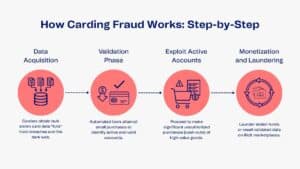
The lifecycle of carding fraud begins with the acquisition of bulk card data, often called “fullz”, which includes names, numbers, expiry dates, and CVVs. Once obtained, the attacker moves to the “testing” phase, where they attempt small purchases—often just a few cents—on unsuspecting websites to see if the transaction is approved.
If the small transaction succeeds, the carder has carding proof that the account is active. They then proceed to more significant purchases or “cash-outs,” where they buy electronics, gift cards, or other liquid assets. This step-by-step progression minimizes the risk of immediate detection by bank fraud departments during the validation phase.
Automation plays a crucial role in every carding attack. Bots are programmed to enter data into payment forms across multiple sites at once. This distributed approach prevents a single IP from being flagged too quickly, allowing the carder to validate hundreds of cards in the time it would take a human to enter one.
The final stage involves laundering the stolen funds or reselling the validated data. By the time a legitimate cardholder notices the small testing charge, the carder has already exploited the account’s full potential. This rapid execution is why carding fraud remains one of the most persistent threats in the digital payments landscape.
Carding methods used by attackers
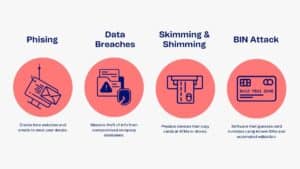
- Phishing and Social Engineering: Creating fake websites or emails to trick users into providing their card details directly to the attacker.
- Data Breaches: Large-scale extraction of payment information from compromised corporate databases or third-party service providers.
- Skimming and Shimming: Using physical devices on ATMs or POS terminals to read the magnetic stripe or chip data from physical cards.
- Bin Attack (Brute Forcing): Using software to guess card numbers based on known Bank Identification Numbers (BINs) and verifying them through automation.
Key indicators of a carding attack in progress
- Unusually High Shopping Cart Abandonment: Bots often test cards by adding items and reaching the checkout page but failing at the payment stage.
- Increase in Low-Value Transactions: A sudden spike in purchases under $1 or $5 is a classic sign of automated validation testing.
- Multiple Failed Payments from One IP: Seeing dozens of declined transactions from a single source within minutes indicates a brute-force bot.
- Inconsistent Customer Data: Discrepancies between the shipping address, the IP location, and the card’s issuing country.
Carding proof and stolen card testing
The search for carding proof is the most critical stage for a cybercriminal. Without verifying the data, they cannot monetize their stolen lists. Carders often target non-profit organizations or small businesses for testing, as these entities sometimes have less rigorous fraud detection systems compared to major retailers.
Once carding proof is obtained, the value of the stolen data increases significantly on the dark web. A validated card with a high credit limit is a high-ticket item. This ecosystem relies on the continuous testing of credentials, making every unshielded payment gateway a potential tool for criminal validation.
At Veridas, we help businesses prevent their platforms from being used as testing grounds. By implementing 100% proprietary AI that detects behavioral anomalies, we ensure that every attempt at gaining carding proof is blocked before it can affect the merchant’s reputation or the victim’s finances.
Stopping the validation phase is the most effective way to break the fraud cycle. If a carder cannot get carding proof on your platform, they will move on to easier targets. This proactive defense is what separates standard security from a truly resilient, identity-based protection model.
Carding attacks with bots and automation
Modern carding attacks are rarely manual. Criminals use sophisticated botnets to perform “card cracking” at an industrialized scale. These bots are designed to mimic human browsing patterns, making it difficult for basic WAFs (Web Application Firewalls) to distinguish between a bot and a real customer.
The scale of these card attacks is immense. A single bot can attempt thousands of combinations per hour across hundreds of different merchant sites. This high-frequency testing allows attackers to find valid cards quickly, maximizing their profit before the banking system can flag the irregular activity.
Furthermore, these bots often use rotating proxies to hide their true origin. By appearing to come from thousands of different residential locations, a carding attack can evade traditional IP-based blacklisting. This level of sophistication requires a shift toward more advanced, device-level and biometric-level security checks.
Veridas addresses this by verifying the integrity of the device itself. Our technology detects emulators, virtual machines, and bots that are commonly used in carding attacks. By ensuring that only legitimate devices and real humans are interacting with your system, we neutralize the threat of automation.
What is the point of carding
The ultimate goal of carding fraud is the rapid conversion of stolen data into untraceable wealth. For many criminals, carding is a low-entry point into a broader spectrum of financial crimes. It provides the initial capital needed to fund more advanced cyber operations or to engage in the illegal trade of goods and services.
Moreover, the point of credit carding is often to exploit the lag between a transaction and its reporting. By performing small tests and then large purchases in a very short window, carders stay ahead of the “remediation curve.” This allows them to extract maximum value before the card is cancelled or the account is frozen.
For organized crime groups, carding fraud serves as a method for large-scale money laundering. By purchasing and reselling items across international borders, they can effectively obscure the source of their funds. This global reach makes it a preferred method for moving illicit money through legitimate e-commerce channels.
From the attacker’s perspective, what is carding fraud is an efficient business model. The tools are inexpensive, the data is abundant, and the success rate remains high for those targeting legacy systems. This makes the transition to biometric-based identity verification the only logical choice for businesses seeking to survive in 2025.
How banks detect carding activity
Banks and financial institutions utilize advanced behavioral analytics to detect carding fraud in real time. They monitor for “velocity” spikes, where a single card is used multiple times in a few minutes, or “micro-transactions” that are typical of card testing. Any deviation from a user’s normal spending pattern triggers an alert.
Geolocation is another key tool for detecting a carding attack. If a card is physically in one country but is used to make an online purchase from an IP address in a completely different region, the transaction may be flagged for manual review or automatically declined based on the bank’s risk policy.
Despite these efforts, credit carding remains a challenge because carders use “clean” IPs and residential proxies to match the victim’s location. Banks are now increasingly looking toward biometric signals and device fingerprints as more reliable indicators of authenticity than simple geographic data or static passwords.
The collaboration between banks and identity providers like Veridas is essential. By integrating our carding proof biometric verification into their mobile apps, banks can ensure that high-risk transactions are only authorized by the legitimate owner through a 3-second voice or face check.
Do carders get caught and legal consequences
While many carding attacks originate from jurisdictions that are difficult to prosecute, international cooperation between law enforcement agencies is increasing. Carders who operate within the EU or US face severe legal consequences, including lengthy prison sentences and significant fines for wire fraud and identity theft.
The digital footprint left during carding fraud is often what leads to arrests. Law enforcement monitors dark web forums and uses blockchain analysis to track the movement of laundered funds. Even the most careful carder can be caught if they make a single mistake in their operational security or device masking.
Furthermore, the use of carding proof technologies by businesses makes it much harder for criminals to hide. When a system identifies a bot or an emulated device, it logs that data, providing valuable evidence for forensic investigations. High-security environments are no longer profitable for average carders.
Legal systems are also evolving to keep up with credit carding trends. New regulations, such as the EU AI Act, provide frameworks for using technology ethically to combat fraud while protecting citizen rights. This balanced approach ensures that the fight against carding is both effective and legally sound.
Comparison of Fraud Detection Technologies
| Technology | Detection Method | Efficiency against Bots | User Friction |
|---|---|---|---|
| WAF (Firewalls) | IP Blacklisting | Low (Proxies bypass it) | Low |
| 3D Secure 1.0 | Static Passwords | Medium (Phishable) | High |
| Behavioral Biometrics | Typing/Mouse Patterns | High | Invisible |
| Veridas Face Shield | Physical Liveness Check | Highest (Impossible to automate) | Ultra-low (3 seconds) |
How businesses prevent carding fraud
To prevent carding fraud, businesses must move beyond static security measures. Implementing a carding proof system involves using AI-driven behavioral analysis to identify bot activity at the entry point. This includes checking for rapid form-filling, unusual mouse movements, and non-human interaction patterns.
Verifying the carding meaning in your specific context is also vital. For e-commerce, this means implementing 3D Secure 2.0 and biometric authentication for high-value transactions. For financial services, it involves ensuring that the person initiating the payment is the same person who was onboarded with a valid ID.
Veridas offers a comprehensive shield against carding attacks through our 100% proprietary technology. By using our biometric engines, businesses can verify identities in milliseconds, ensuring that stolen card data is useless without the physical presence of the legitimate owner.
Finally, a robust defense requires continuous monitoring. Carding attacks are not one-time events; they are persistent efforts to find vulnerabilities. By utilizing our Business Intelligence dashboards, companies can track fraud attempts in real-time and adapt their security thresholds dynamically.
How to protect yourself from carding attacks
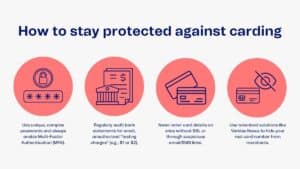
As a consumer, protecting yourself from carding fraud starts with basic digital hygiene. This includes using unique, complex passwords for every account and enabling multi-factor authentication (MFA) whenever possible. Regularly reviewing your bank statements for small, unfamiliar charges is also a key habit.
Be cautious of carding methods like phishing. Never enter your credit card information on a site that does not have a valid SSL certificate or that you reached through a suspicious link in an email or SMS. Legitimate companies will never ask for your full card details or PIN over unencrypted channels.
Utilizing digital wallets like Veridas Nexus can also provide an extra layer of protection. These systems use tokenization and biometrics, meaning your actual card number is never shared with the merchant. This makes it impossible for an attacker to steal your data even if the merchant suffers a breach.
Ultimately, the best defense against a carding attack is awareness. By understanding what is carding fraud and how it works, you can take proactive steps to safeguard your identity. Stay informed about the latest threats and rely on companies that prioritize your privacy and security through advanced technology.
Use Cases by Industry
| Industry | Use Case Description | Veridas Solution |
|---|---|---|
| Banking | Secure high-value transfers and prevent account takeovers by verifying the account holder’s identity via voice or face. | Veridas CORE & ECHO |
| E-commerce | Prevent automated bot attacks on checkout pages and reduce fraudulent chargebacks through biometric validation. | Veridas Face Biometrics |
| Insurance | Verify the identity of claimants to prevent fraudulent payouts and ensure the legitimacy of the policyholder. | Veridas Identity Verification |
| Fintech | Streamline digital onboarding for new users while complying with AML/KYC regulations at an industrialized scale. | Plug&Play Identity Platform |
Frequently Asked Questions (FAQs)