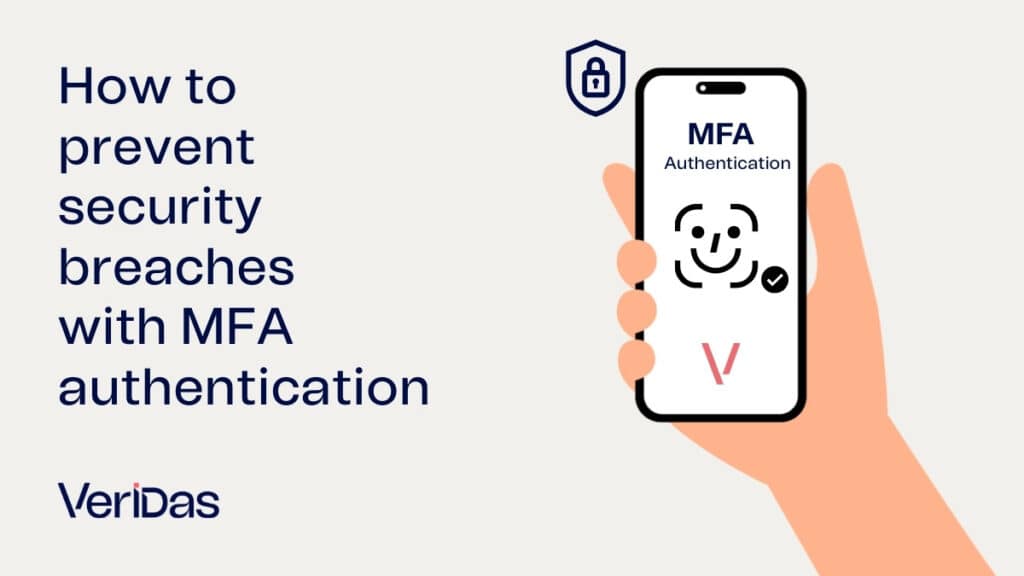
Security breaches remain a critical threat to organizations despite the widespread use of traditional credentials. This executive digest explains how to prevent security breaches with MFA authentication by leveraging biometric factors.
According to global data, stolen credentials cause a significant portion of successful attacks. MFA authentication adds a mandatory second layer of identity verification that blocks unauthorized access effectively.

Implementing inherent factors like face authentication or voice biometrics provides certainty about the person’s identity. Traditional MFA methods, such as SMS or hardware tokens, are susceptible to interception or theft.
Modern biometric MFA ensures that the person accessing a system is the legitimate owner. This guide details how robust authentication strategies protect sensitive assets and mitigate the financial impact of cybercrime.
Why data breaches still happen despite strong passwords
Passwords are inherently fragile because they rely on shared knowledge that can be stolen or guessed. Even the most complex alphanumeric combinations are vulnerable to social engineering and phishing attacks.
Attackers use sophisticated tools to capture credentials through fake login pages or malware. Once a password is leaked, the security of the entire account depends on additional layers of verification.
The password reset process is often the weakest link in a company’s security perimeter. Attackers exploit these recovery flows to bypass original credentials and gain unauthorized account access.

Implementing a password reset secured by voice biometrics eliminates these vulnerabilities instantly. By verifying the user’s unique voice pattern, you avoid the risks associated with shared secrets or codes.
Credential theft is the primary cause of over 80% of security breaches according to recent industry reports. Password reuse across different platforms further increases the risk of massive data exposure for companies.
When one service is compromised, attackers attempt to use the same credentials on other corporate systems. This lateral movement allows unauthorized individuals to access sensitive databases without triggering immediate security alerts.
MFA as a regulatory requirement: DORA and NIS2
Compliance with modern frameworks is no longer optional for organizations managing critical infrastructure. Regulations like DORA and NIS2 explicitly mandate the use of MFA to protect sensitive data and systems.
The DORA regulation (Digital Operational Resilience Act) requires MFA for access to critical data and systems. Biometrics are recognized as a key factor to ensure operational resilience in the financial sector.
Under NIS2, organizations must implement MFA or continuous authentication to shield sensitive information. This directive aims to increase the common level of cybersecurity across the European Union and its partners.
Failing to implement robust MFA can lead to significant legal penalties and reputational damage. MFA authentication is the technical standard required to meet these high-level security and compliance demands.
How MFA helps reduce the risk of security breaches
MFA authentication requires users to provide two or more different types of evidence to verify their identity. This approach follows the principle of combining something you know with something you are.
By introducing these steps, organizations can prevent security breaches with MFA authentication effectively. Even if an attacker obtains a password, they cannot gain access without the biometric factor.
The effectiveness of MFA depends largely on the nature of the factors chosen by the IT team. Inherent factors, such as facial biometrics, offer the highest level of security and certainty for the organization.
Unlike physical tokens, biometric traits cannot be lost, stolen, or shared between different individuals. This ensures that the person performing the action is the legitimate authorized user at all times.
Attack vectors that MFA can block
- Phishing: Blocks access even if the user inadvertently shares their primary password or recovery codes.
- Brute Force: Neutralizes automated password guessing by requiring a physical biometric validation.
- Credential Stuffing: Prevents the use of leaked passwords from other platforms on corporate systems.
- Social Engineering: Mitigates deception since biometric traits cannot be easily shared or replicated by voice.
Scenarios where MFA significantly limits attacker access
| Scenario | Risk Level | MFA Impact |
|---|---|---|
| Remote Access (VPN) | High | Prevents entry from unauthorized or compromised home devices. |
| Privileged Accounts | Critical | Blocks lateral movement and unauthorized system configuration changes. |
| Financial Transfers | High | Ensures non-repudiation and prevents banking fraud effectively. |
How to integrate MFA into a broader security strategy
MFA should be integrated as part of a zero trust security architecture where no user is trusted. Every access attempt must be verified regardless of the network or device being used.
Implementing zero trust security requires continuous authentication to ensure vothe person’s identity hasn’t been compromised. Biometric factors provide the necessary certainty to maintain this “never trust, always verify” model.
Connecting MFA with an Identity and Access Management (IAM) platform allows for centralized control of all users. This enables security teams to detect suspicious patterns and login attempts in real time.
MFA is also essential for access control to critical systems and facilities, bridging physical and digital security. Verifying identity at the door or at the server ensures total perimeter protection.
Veridas
Veridas provides a world-class biometric engine that has been ranked second in global NIST evaluations. Our technology enables organizations to prevent security breaches with MFA authentication easily.
We offer 100% proprietary solutions for facial and voice biometrics, ensuring maximum control and security. Veridas technology is designed to be inclusive, unbiased, and compliant with regulations like DORA and NIS2.
Our liveness detection technology is certified by iBeta at levels 1 and 2 for all environments. This provides the highest level of protection against presentation attacks, deepfakes, and identity theft.
Veridas capture SDKs offer a guided user experience that maximizes conversion while ensuring integrity. We help businesses build trust by verifying the real identity of their users in seconds.
Use cases by industry
- Banking: Secure remote account opening and transaction authorization to mitigate banking fraud.
- Critical Infrastructure: Access control to systems and physical facilities using biometric MFA.
- Telecommunications: Preventing SIM swapping and securing password reset flows with voice biometrics.
- Insurance: Verifying identity for claims management and policy renewals securely and remotely.
- IAM Management: Centralized identity and access management for employees and third-party vendors.